
Most recruitment agencies run on a single revenue model: find a candidate, place them, collect a fee. It works — until it doesn't. One slow quarter, one lost retainer, one client freeze and the whole business feels fragile.
The agencies that grow consistently aren't just better at placing candidates. They've built multiple revenue streams from the same activity they're already doing. And the surprising part? Most of the assets they need already exist inside their database.
Here's how to think about adding revenue streams to your recruitment agency — and what's actually realistic to implement.
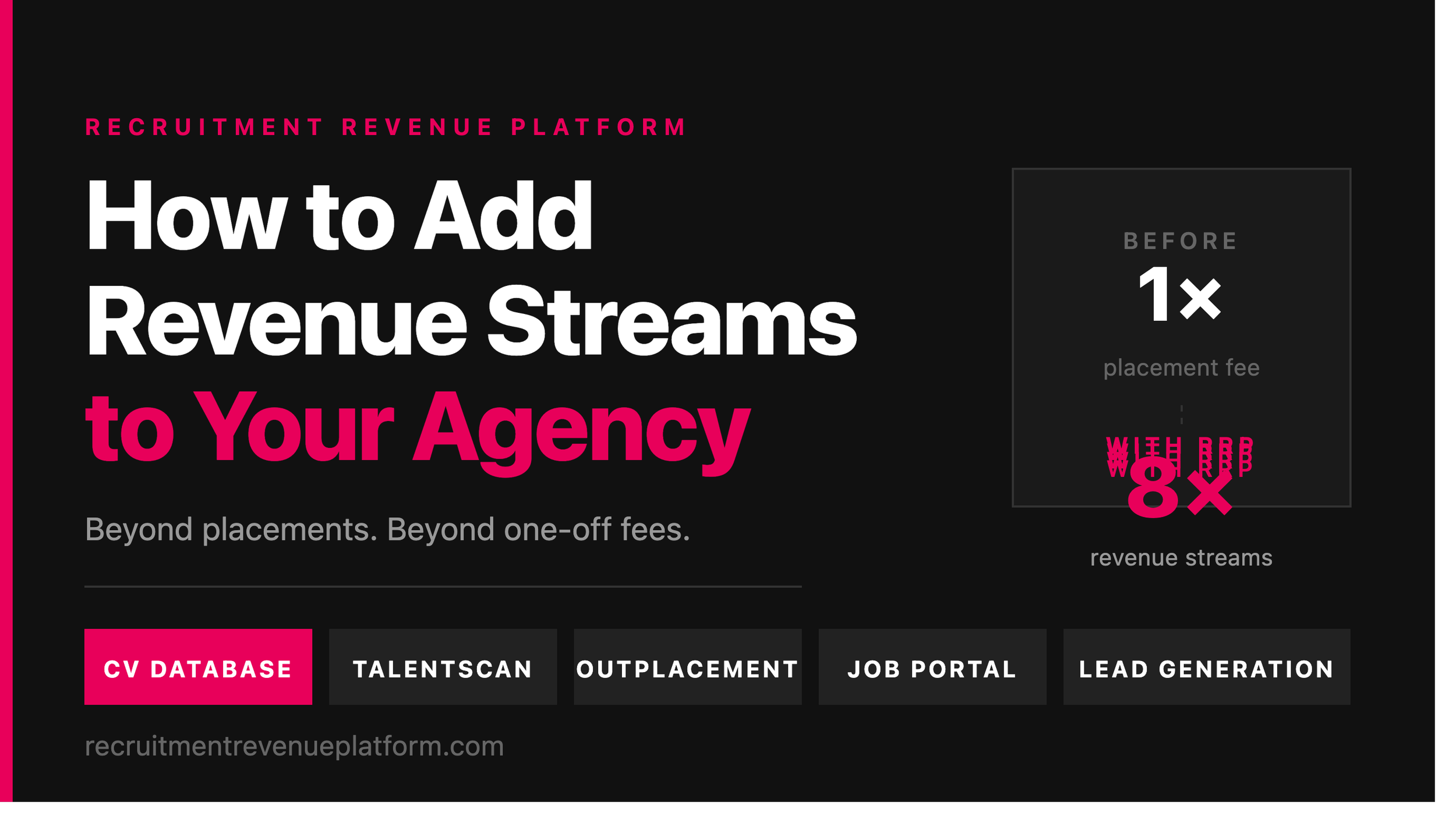
Why recruitment agencies stay stuck on one revenue stream
The recruitment industry was built around the placement model. Every ATS, every CRM, every process was designed to move candidates from application to offer. That's the metric, that's the workflow, that's where the revenue goes.
The problem is structural. When your technology only measures placements, you only see placement revenue. Everything else — the 99% of candidates you don't place, the market intelligence you accumulate, the employer relationships you build — becomes invisible from a revenue perspective.
It's not that agencies lack assets. It's that their tools don't know what to do with them.
The 5 revenue streams most agencies are sitting on right now
1. CV database monetization
The average recruitment agency has thousands of candidates in its database. Most of them were never placed — not because they weren't good, but because the timing was wrong or the brief didn't fit. Those CVs are not dead leads. They're a pre-qualified talent pool that other businesses would pay to access.
Database monetization means packaging your existing talent pool as a service — subscription access for hiring managers, talent pipeline reports for specific sectors, or curated shortlists on demand. You already did the sourcing work. This turns that work into recurring income.
2. TalentScan — turning rejected candidates into a sales asset
When a candidate is shortlisted but not placed, most agencies send a polite rejection and move on. TalentScan flips that logic: the rejected top candidate becomes a proactive outreach opportunity to new clients.
The mechanic is simple — you identify which other companies in your market would want to see this candidate, reach out with a warm, targeted introduction, and either make a new placement or open a new client relationship. One candidate, multiple commercial opportunities.
3. Outplacement and downsizing services
Companies restructure constantly. When they do, they need to support the employees they're letting go — CV writing, career coaching, job search assistance. This is outplacement, and it's a well-established market that most recruitment agencies ignore despite being perfectly positioned to deliver it.
If you already work with HR departments, you're one conversation away from offering outplacement as an add-on service. The margin is strong and the competition in most markets is thin.
4. Job portal subscriptions
Most agencies drive candidates to apply through generic job boards. But your agency has its own audience, its own sector authority, and its own candidate relationships. A branded job portal — where candidates pay a small subscription for priority access to roles, career resources, or direct recruiter contact — turns that audience into a recurring revenue line.
The same portal can generate revenue on the employer side: premium listings, featured roles, or subscription access for hiring managers who want first refusal on new candidate registrations.
5. Automated lead generation as a client acquisition engine
The fifth stream isn't a product you sell — it's the infrastructure that feeds everything else. Automated lead generation means using market intelligence tools to identify companies with active hiring needs before they post a job, reach out at the right moment, and convert them to clients systematically rather than through cold calling and gut instinct.
When lead generation is automated and data-driven, your business development output stops depending on the energy levels of individual consultants. It becomes a process — measurable, scalable, and predictable.
What this actually requires
Adding revenue streams isn't a strategy problem. Most agency owners can describe these models in theory. The gap is operational: how do you run five revenue lines without five times the headcount?
The answer is that most of these streams can be automated or semi-automated with the right platform. Market intelligence identifies the right companies to approach. TalentScan widgets run candidate-matching in the background. Job portals generate inbound interest without manual sourcing. Database monetization can be packaged into a product once and sold repeatedly.
The agencies that implement this successfully aren't working harder. They're running a different kind of business — one where the work they've already done keeps generating returns, instead of resetting to zero after every placement.
Where to start
If you're running a recruitment agency and you're relying on placement fees as your primary or only income source, the most immediate thing to do is audit what you already own:
How large is your CV database, and how much of it is active?
What percentage of candidates you shortlist don't get placed?
Are you currently offering any services to companies going through restructuring?
Do you have a branded presence candidates trust, or are you sending them to generic job boards?
The answers usually reveal that the assets are already there. The question is whether your technology and processes are set up to turn them into revenue — or whether you're leaving them idle.
Recruitment Revenue Platform combines STAA and NewTalentBase to give recruitment agencies the infrastructure to run multiple revenue streams from a single platform. If you want to see how this works in practice, book a demo here.